



This post contains spoilers for Jurassic World Rebirth.
Since the release of the classic "Jurassic Park" directed by Steven Spielberg in 1993, the "Jurassic" series of films have dominated the dinosaur-themed films for more than thirty years.These films not only shocked the audience with their amazing visual effects, but also left a strong mark on the innovation of film technology. Jurassic Park is one of the first works to introduce computer-generated images (CGI) into mainstream film production, But it doesn't rely entirely on digital effects—what really brings the film to life is its clever blend of CGI with amazing physical mechanical dinosaur models.And it is this that seems particularly missing in the latest sequel, Jurassic World: Rebirth.
This new work directed by Gareth Edwards (whose masterpieces include Godzilla and Rogue One) is set five years after the incident of "Jurassic World: Ruling". Earth ecology is no longer suitable for dinosaur survival, Most of the surviving dinosaurs live in isolated environments near the equator far away from human civilization.A scientific team was sent to Isabella Island, an experimental base used by scientists in the "Jurassic World" to collect critical DNA samples that contain the potential to save lives.
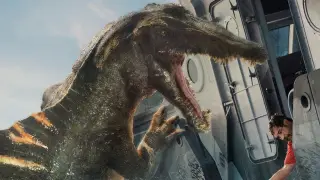
There are many types of dinosaurs in the film, and even a brand new mutant Tyrannosaurus Rex (D-rex) appears.However, the problem is also here - every dinosaur is built on CGI alone, and no real mechanical model or puppet appears.Although some of the CGI images are indeed amazing, the lack of the realism brought by physical dinosaurs is unignorable.
Looking back at the previous work, although "Rule" has been controversial, But many hand-controlled dinosaur puppets are still retained, In particular, some of the shots of the Behemoth Dragon are impressive, almost regaining some soul in the whole movie.(However, the settings of those giant locusts are still a regret that many people cannot let go of.)
Even after entering the "Jurassic World" era, all works rely more on CGI, but each of them still retains a certain number of mechanical dinosaurs.Producer Frank Marshall once proudly stated that Fallen Kingdom uses more physical models than any previous one. Whether you like these works or not, it is undeniable that those dinosaurs that actually appear in front of actors can always bring an irreplaceable real texture.
So, why did Rebirth give up this tradition?/Film reporter Jeremy Marseille interviewed director Gareth Edwards to try to uncover the mystery:
In the 2014 "Godzilla", Edwards cleverly used CGI to create a monster image, He also showed how to use digital technology to create a blockbuster atmosphere in his low-cost debut "Monsters", and successfully combined real-time special effects and CGI in "Rogue One" to create a very textured picture.Unfortunately, Jurassic World: Rebirth failed to continue this balance.
“My background is computer graphics and visual effects. But in some projects, I gradually realized one thing: Sometimes we have to work hard to build physical models and eventually they will be replaced with CG. While the process is very worthwhile – it provides reference material to help actors perform better on the shooting site, and the overall effect may be better. But we only have less than a year and three months, which means we don’t even have time to preview previews of early visualizations, action designs, and animations for key scenes.Therefore, it is almost impossible to create a large, complex mechanical dinosaur model.That would consume a lot of resources and time, and we wouldn't have time at all.”
We can understand the director's explanation from multiple perspectives.I am not a filmmaker and I cannot tell how many difficulties there are in actual shooting that will lead to physical effects failure.But I know one thing: the production cycle of this movie is extremely tense. Until January 2024, People only learned that David Kopo, the former screenwriter of "Jurassic Park", will return to participate in script creation, There are only 18 months left before the release.For a large production of this scale, such preparation time is too hasty.
The most fundamental problem may be the pressure of time.It takes a long cycle to make a precision mechanical dinosaur model, and various accidents may occur during the process. The Tyrannosaurus in "Jurassic Park" frequently went on strike due to rain failure, But Spielberg's clever response has actually made one of the most exciting scenes in film history.
However, this time, in order to seize the prime time of the 2025 summer season, Universal Pictures chose efficiency first.Business considerations overwhelm artistic pursuits—an inevitable part of the film industry.Faced with a tight schedule, Edwards and his team had to choose a more efficient and faster CGI route. The Spinosaurus in "Jurassic Park III" is one of the most outstanding mechanical models in the series' history, But in "Rebirth", this creature is completely presented by CGI, and the effect is obviously incomparable.
The audience can feel all this change.To be honest, my personal love for "Rebirth" is far more than "Falling Kingdom" and "Rule", but it is undeniable that the most touching moments in these two works come from those real dinosaur models.Although excellent physical effects cannot save a movie with a weak plot, they can indeed make the entire viewing experience more immersive and realistic. If "Rebirth" could also add some of this "old-school" craftsmanship, perhaps its charm would be more complete.
Jurassic World Rebirth is now popular in theaters.